

Hi Friends,
Ethnically I’m mostly Vietnamese. The other bit, I don’t know.
The reason why I don’t know is because my maternal family doesn’t know either. We don’t know our ethnic roots. What we do know is that my great great grandfather had to flee his country, the most plausible theory being China, to Vietnam under a new alias. A family in the north of Vietnam took him in, and he married their daughter and adopted their surname: Vũ.
Two generations later, war broke out. Vietnam was caught in the struggle between Capitalism vs Communism. Communism won. Fearing for their lives, my maternal family fled to the United States. My grandparents instead took all seven of their children and fled to the United Kingdom. Given how often my family has migrated, it’s safe to say that they don’t have a sense of where home is.
I’ve inherited this feeling. All my life, I’ve felt this yearning to find home.
Birmingham, the city I was born and raised in has always felt off. There’s nothing wrong with it, but it has never felt like home. When I moved to London, despite it feeling like the closest thing to home, there was something still missing. I thought the answer to my yearning was in the ‘motherland’. So at the age of 26-27, I flew over and spent up to nine months exploring my culture and heritage. But I continued to feel too strange for home and too strange for Vietnam. Never enough for both.
Stories — The lens in which we see the world
Recently, I’ve been meeting a lot of new people, and when they ask me what I do, I struggle to come up with an answer. I usually say, “I do multiple things. I’m an editor, I’m a copywriter, I’m an entrepreneur, I’m an essayist.” But I’ve been thinking a lot about this and at the core of what I really am is a storyteller.
Despite a lot of what I do revolving around writing, the distinction of being a storyteller is small but important. Stories can be anything. They can be art, comedy, music, movies, history, videos, or photos. Stories are the lens through which we see the world and ourselves. And so I aim to see the world more clearly.
There’s something powerful in stories. As a storyteller, the greatest power I wield is to shine a magnifying glass on what people recognise but haven’t consciously thought about or seen. The highest compliment I can receive is, “I really felt that. I thought I was the only one who felt that way.” We all want to feel seen. We all want to feel a little less lonely. We all want to belong.
The paradox of belonging
I recently finished Steppenwolf by Hermann Hesse and thought it was a brilliant read. I related to how the protagonist, Herr Haller, consciousness causes him to suffer: simultaneously drawn and repulsed by the bourgeoisie society, the battle between elitism versus mediocrity, and the loneliness he suffers.
It got me thinking about why I enjoyed it so much and what makes a good story. The answer I came up with is this: all great stories are about belonging. Finding where you belong, proving you belong, or fighting to belong.
This simple truth is the key to understanding human nature. Our purpose for existing is to belong.
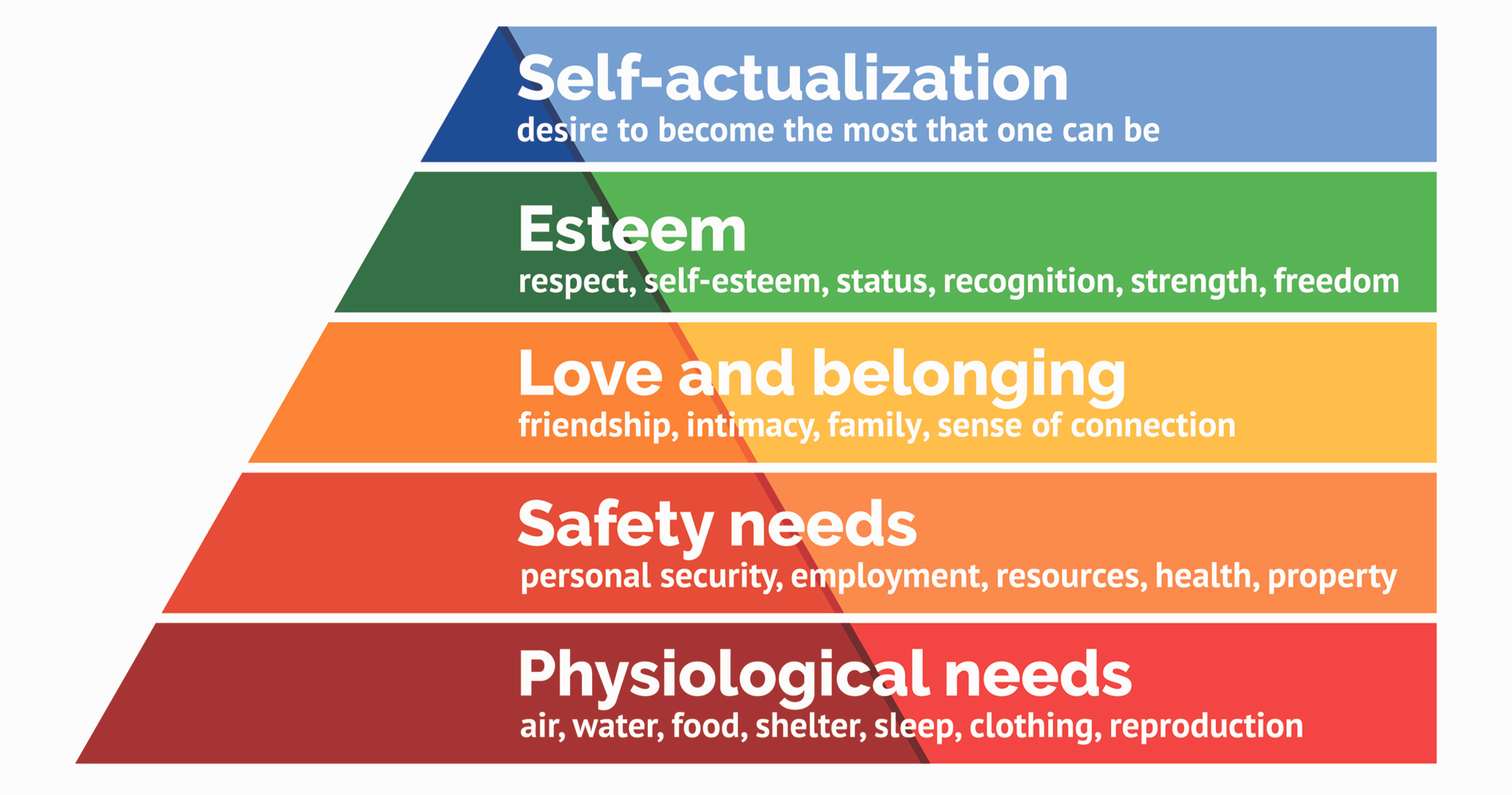
This desire to belong is as much foundational as well as aspirational. When we take a look at Abraham Maslow’s Hierarchy of Needs — Physiological, safety, love, esteem, and actualisation — they all point towards belonging.
But for belonging to thrive, it paradoxically requires boundaries: knowing yours and respecting others.
When we acknowledge boundaries with humility and grace, we make each other feel safe and supported.
Humanity’s north star
When communities begin to break, their sense of belonging buckles and crumbles away. In-groups start to form and clash with the outgroup. “You don’t belong here.” “You’re not one of us.” “It’s no longer safe here.” The margins are squeezed until the marginalised are wrung out.
Yet when communities flourish, everyone feels as though they belong. “You’re always welcome here.” “This place feels like home.” “We are in this together.” The gentle strength of great communities rustles in the spring breeze of a warm embrace.
No civilization in history has managed to hold on to this completely, yet it is the north star we continuously strive towards.
Finding home
We all want to belong: to a home, a family, a community, a country. Whether we want a title, a chance to prove ourselves, or a love to come home to, we want to know we earned our rightful place and that others acknowledge what we’ve done.
We exist to belong. That’s all there is to life. Every struggle, movement, marriage, country, migration, love, or language. Even violence is a negative form of belonging. All this is to feel seen, to feel safe, to be ourselves, to be remembered, to be loved – this is the puzzle of life which we try to solve.
Last year when I moved back to Birmingham, my intention was to find stability whilst I navigated the uncertain terrain of entrepreneurship. The plan was to execute on my ideas and get back to London once I managed the uncertainty.
Despite feeling restless in the city I grew up in, recently, my heart has softened towards it. Not because the city is changing, great food places are opening, or opportunities arising. Because I’ve found an in-real-life community that has finally made me feel like I belong: my climbing community. We’re all adventurous. We’re all pushing each other to be the best we can be. We’re all flirting with risk. I started to feel a sense of peace, a sense of freedom, and a sense of home. London no longer feels so desirable.
When we have no reasons left to run, chase, or escape, our souls finally rest and find peace. There lies the paradox in our yearning for belonging: Only through belonging will we ever find home, yet only through belonging will we ever be free.
— Jason Vu Nguyen
Climbing! Now we have some common ground. I've always thought of rappelling as a well earned dessert!