

*Apologies for the late email this week. I was down in London yesterday for the Foster.co dinner.

Hey Friends,
Most people think there’s a direct relationship between the effort you put in and the success you will get out.
Poker quickly disabuses you of this notion.
Because in a game of poker, you can put the highest quality of effort in and still lose. You can make all the right decisions, and luck can go against you. The idea is hard to wrap your head around and sounds terrifying, but it teaches you that success is nonlinear. This discrepancy is why many people give up before they reach the reward.
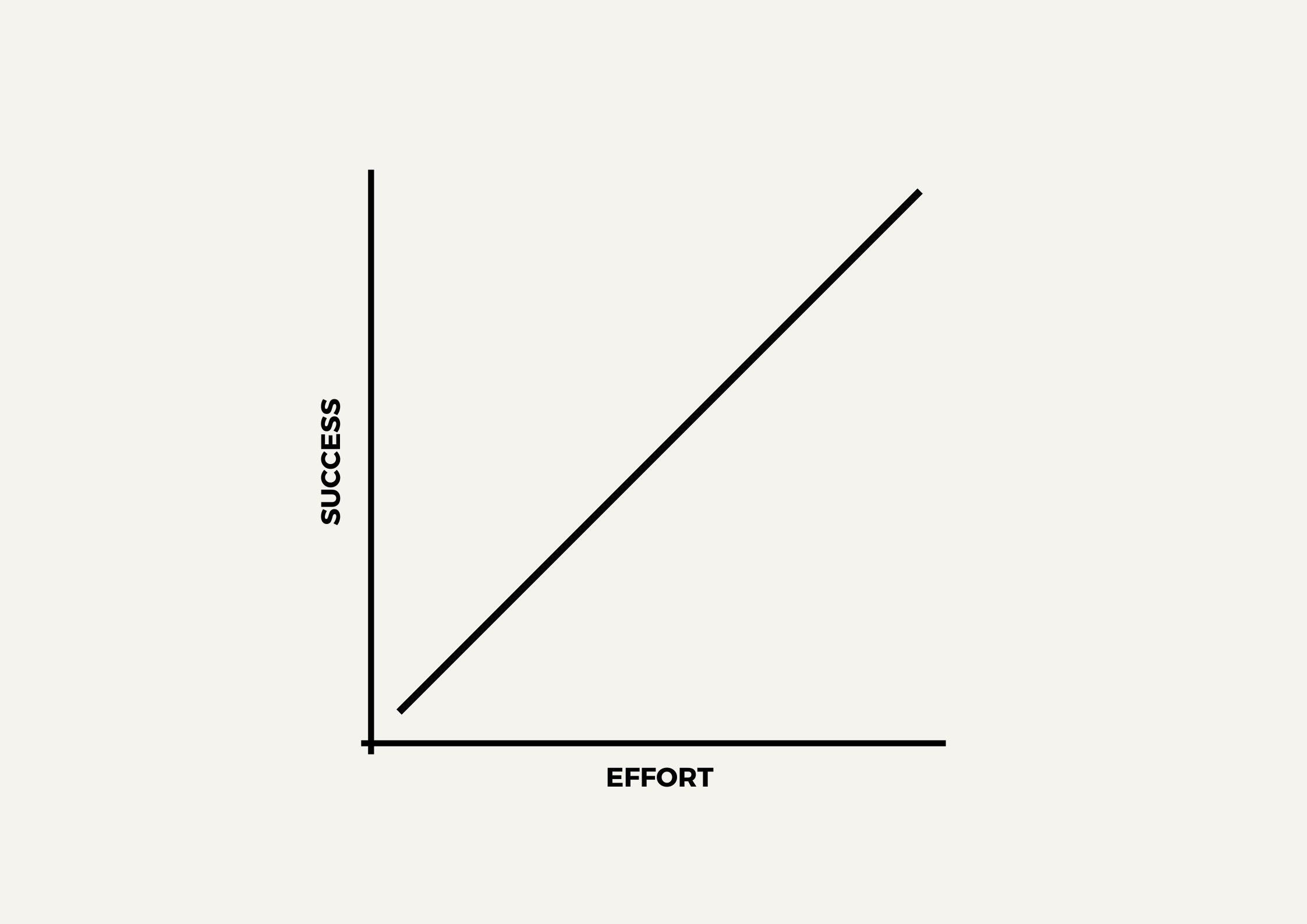
We, humans, are wired to think in a linear way. Our brains tell stories to help us understand and simplify the complex and multivariate world. This is why storytelling is so effective because most stories emphasise a cause-and-effect relationship. But life is largely random.
In Fooled By Randomness, Nassim Nicholas Taleb writes:
“People think that if, say, two variables are causally linked, then a steady input in one variable should always yield a result in the other one. Our emotional apparatus is designed for linear causality... If you do not feel that you are going anywhere, your emotions will cause you to become demoralized.”
It’s why people struggle to stay committed to getting in shape. They’ll go to the gym 5x a week for four weeks straight but then become discouraged when they can’t see any progress. Sure, they may have worked out hard and lifted some heavy weights, but it didn’t translate to success, at least not yet. The input didn’t equal the output. And so, many abandon their gym commitments because it “didn’t work”.
You’ve got to show up and compound your efforts. Compounding is essential for success. However, the self-help industry has exploited this idea to death. It’s quoted and iterated endlessly: “Just get 1% better each day, and you’ll be 37x better in a year.”
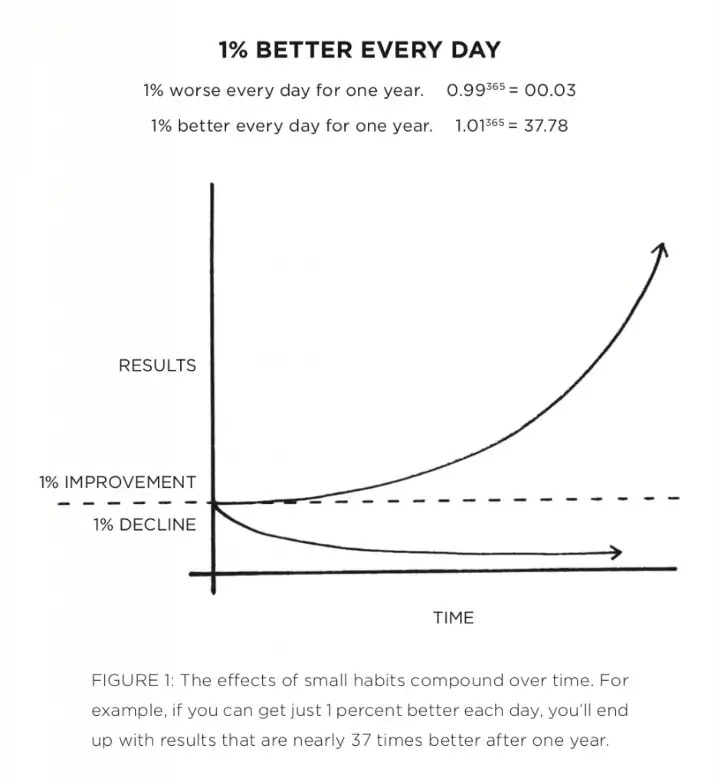
Sure, it’s a fun stat to visualise. It allows change or success to seem more tangible, but there are a few problems with this approach.
Let’s go back to poker, a world where it is competitively cutthroat. If you took a snapshot of my result, they’d look nothing like the graph above. A typical week of results would look like this:
Monday: +$770.00
Tuesday: -$1520.00
Wednesday: +$3200.00
Thursday: -$590
Friday: +$6500
Saturday: -$4450
Sunday: (It’s Sunday Funday, I got this. Let’s go!) -$50…
Total for the week: +$3860 (win 3 days out of 7)
In poker, how fast you can adapt your strategy is everything. So you have to be mentally on point. Your ability to exploit and dominate garners respect and helps you win. But some days, luck and variance punch you in the face, kick you whilst you’re fumbling around and spit in your face for good measure. You learn that fortune can be given and taken away at a flip of a card. Yet if I’d subscribed to the 1% better plan, I’d have only felt even more demoralised that I didn’t achieve my results.
Poker is very reminiscent of real life. Sometimes, we can do everything right and still lose. Other times we can do everything wrong and win. Hence, the 1% better analogy is broken.
Another problem with this advice is that you can’t always operate at peak performance, nor can you control it. You can’t predict how you’re going to perform each day. There would be days when I’d wake up feeling like a million bucks but made terrible decisions in a session. And there would be some days when I’d wake up after four hours of sleep with a pounding headache from drinking my dinner but play poker in God mode.
Getting 1% better each day isn’t sustainable. You have to think of yourself more like a stock market. There will be plenty of ups and downs. It’s erratic and contains long periods of no progress. And then, when you win, you win big.
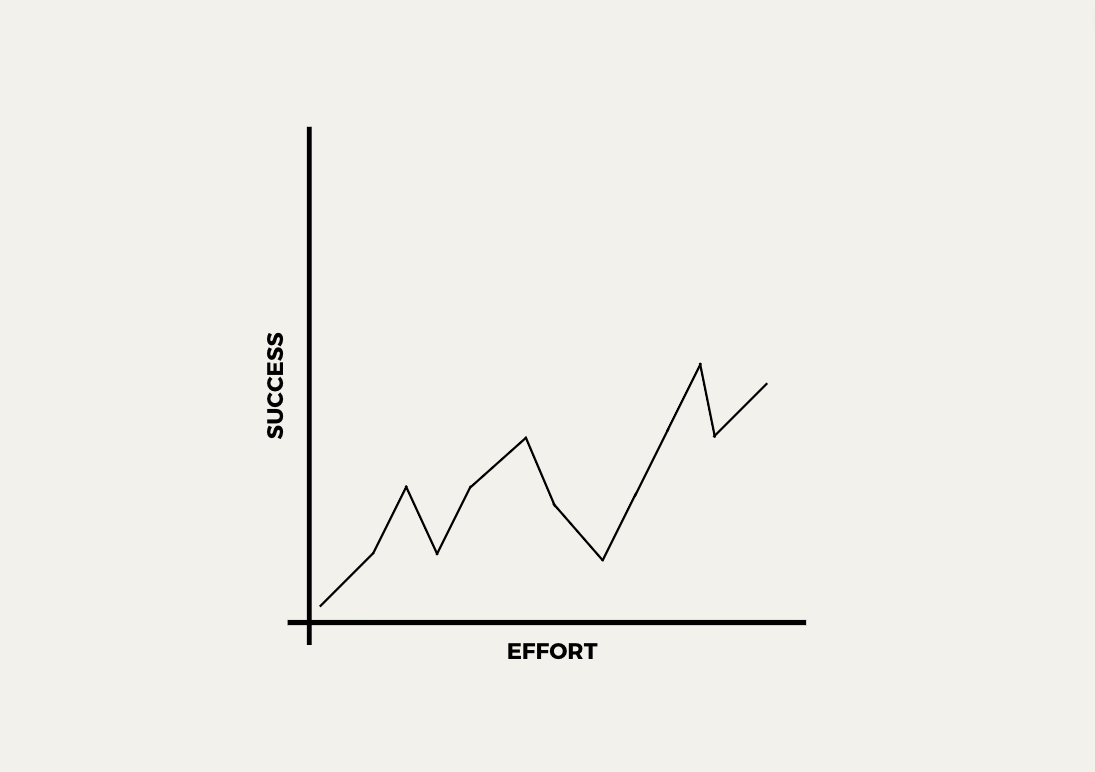
Our brains don’t like this story because it’s not neat and simplistic. It’s too complex for us to understand. Also, the story of “I worked hard for ten years and accomplished nothing. Until the 11th year, everything clicked, and now I’m rich” doesn’t have a great appeal to it.
But that was how it was in poker for me. The first five years of my career were mediocre. In one of the years I only earned £12,569 whilst living in the most expensive cities on earth. Honestly, I was better off staying in my corporate job, which paid me a £25,000 annual salary.
There were many moments when I thought about throwing in the towel — either going back to corporate or getting a master’s — but my then-girlfriend told me to concentrate on one thing and to stop fantasising about chasing new ideas. So I continued playing poker, and in 2018 it all came at once. I ascended from small stakes to mistakes to high stakes very quickly. I went from losing or winning a few hundred dollars to swinging annual salaries in a single hand.
It’s hard to grasp why suddenly, with one additional effort or move, you see a giant disproportional impact. But to make this idea more comprehensible, let’s think of a sandcastle. Imagine for one second it’s a hot summer day, and you decide to head to Santa Monica beach. You spend hours building the biggest and most impressive sandcastle. You add one grain of sand at a time when suddenly, the whole castle comes tumbling down.
You could argue that the last grain of sand is responsible for the destruction of the sandcastle. But what you’re witnessing is a nonlinear effect resulting from a linear force/action exerted on the sandcastle. A small input caused a disproportionate result. Or you may have heard such wisdom expressed in the well-known phrase, “the straw that broke the camel’s back.”
As I’ve made the leap from poker to business and writing, my approach has been to look for disproportionate results. Most people quit when things are going nowhere or downwards because they don’t understand the amount of work you put in does not correlate to the amount of success you enjoy at any given moment. And no, I’m not being hyperbolic about this claim either because I, too, make this mistake as much as the next person. I came up with many ideas in 2022, but they failed a few months later because of a lack of perceived progress. It’s always so easy to give up in the downswings.
As Taleb writes:
“Reality rarely gives us the privilege of a satisfying linear positive progression: You may study for a year and learn nothing, then, unless you are disheartened by the empty results and give up, something will come to you in a flash.”
The sudden flash is the big upswing. It’s a rare event (a black swan) that changes the game. Going through long periods of no progress is a requirement for success. Hence why loving the journey more than the destination is so important.
In poker, success happens in spurts over time. You can spend hours folding for you to suddenly then win a big pot. It’s a bumpy, random, and frustrating journey. The path was emotionally and mentally exhausting. Because when the input does not equal output, it’s impossible to know when you’re reaching the tipping point, and most people give up before they find it.
So how do you know what project or path to keep pursuing?
Or which ones to abandon, given time is finite?
A good rule of thumb is to pursue the path that has quickly revealed some success. Let me explain.
I was a No-Limit Texas Holdem (NLHE) cash game specialist, but my poker career didn’t start out this way. I tried many variants before finally settling on being an NLHE cash game player. I played sit’n’gos, tournaments, draw poker and so on. But I picked NLHE cash games because I found some success early on, and from there, I doubled down.
I’ve taken this approach to business and writing too. I entered a phase of exploration and detached myself from one business idea. Instead, I started a dozen business ideas, and 95% were failures. But what I know from poker is that if something starts out well, it generates momentum and is likely to lead to that thing working out. Small success grows into big ones. Failure rarely does.
The reason why my writing, copywriting business and coffee business still persists is, well, I found early wins in them. My first published piece on Medium did well. When I went all in on writing, a few days later, I landed my first client. I sold my first bag of coffee before I launched my coffee business officially.
You don’t have to win big straight away. Find easy and early small wins and use that to generate momentum forward.
“The harder I work, the luckier I get”
You’re probably wondering at this point if effort and success don’t have a linear relationship, then should you stop working so hard?
Of course not. Because the right effort can also generate luck. There’s a saying by professional poker player Jason Mercier, “the harder I work, the luckier I get.”
After making a switch from poker to writing, I’ve found this has stayed true. Showing up everyday has opened me up to opportunities that I wouldn’t have had otherwise. I’ve developed great new relationships and worked on some cool projects.
The right hard work can pull luck in your direction, which leads to opportunities, small wins and then eventually big success.
So keep going.
Be mindful of the downswings and flat stretches.
But remember, keep turning up everyday and do everything you can to trend upward towards success.
— Jason Vu Nguyen